Natural Allergy Benefit
Natural Allergy Benefit
Capricare® whole goat milk formula is lower in key allergens and may reduce the risk of eczema
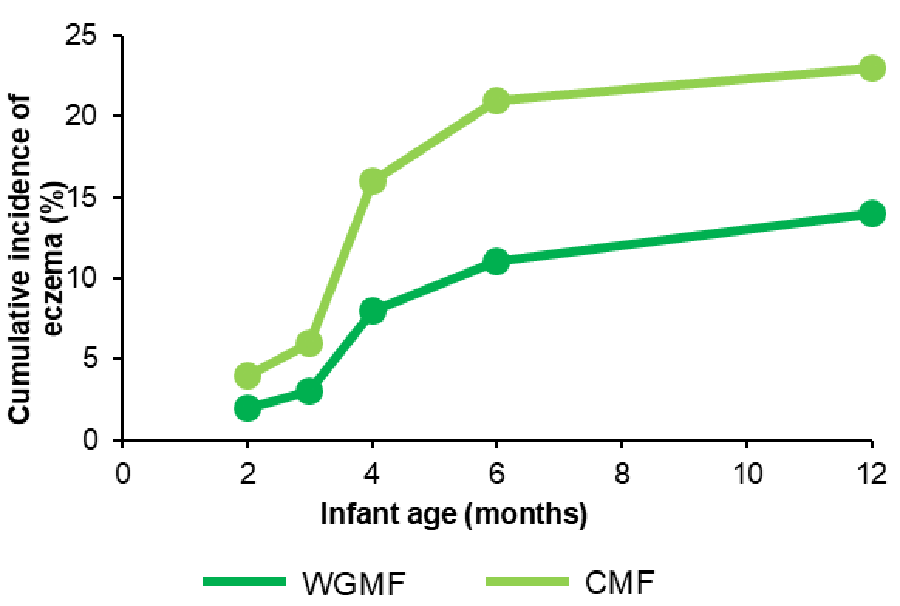
A post hoc analysis of a randomised controlled trial of 200 formula-fed infants to assess growth and nutritional status, showed a trend of lower cumulative incidence of eczema with whole goat milk formula, compared to standard cow milk formula.1
Lower in key allergens
There are 2 key allergens in standard cow and goat milk formulas; alpha-S1 casein and beta-lactoglobulin.2,3,4
Human milk does not contain the key allergen, beta-lactoglobulin. Beta-lactoglobulin is found in the whey fraction of cow and goat milk. When whey is added to a milk formulation; ie ‘whey-adjusted’, the beta-lactoglobulin component of that formula is increased. Unlike cow milk formula, Capricare whole goat milk formula has no whey added and therefore, has a lower amount of the key allergen, beta-lactoglobulin, compared to whey-adjusted formulas.2-4
- Capricare® whole goat milk formula contains ~11% beta-lactoglobulin of total protein.5
- Standard whey-adjusted goat and cow milk formulas contain >34% beta-lactoglobulin of total protein.5
Like human milk, Capricare® whole goat milk formula contains lower levels of alpha-S1 casein, when compared to standard cow milk formula.6 Furthermore, when alpha-S1 casein is sourced from goat milk, it has been shown to be less sensitising compared to alpha-S1 casein sourced from cow milk,7 suggesting that it is not only the lower levels of alpha-S1 casein, but also the goat milk source that supports the allergy benefits of Capricare® whole goat milk formula.
Cumulative incidence of eczema over 12 months in infants fed whole goat milk formula or standard cow milk formula
Comparison of amounts of key allergens, beta-lactoglobulin and alpha-S1 casein, in human milk, whole goat milk formula and whey adjusted goat and cow milk formulas*.2-5
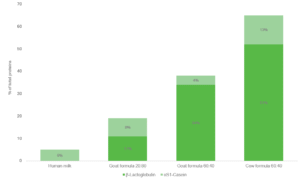
*Typical levels calculated based on levels reported in the scientific literature and assuming a 60:40 whey to casein ratio
More efficient digestion of key allergens
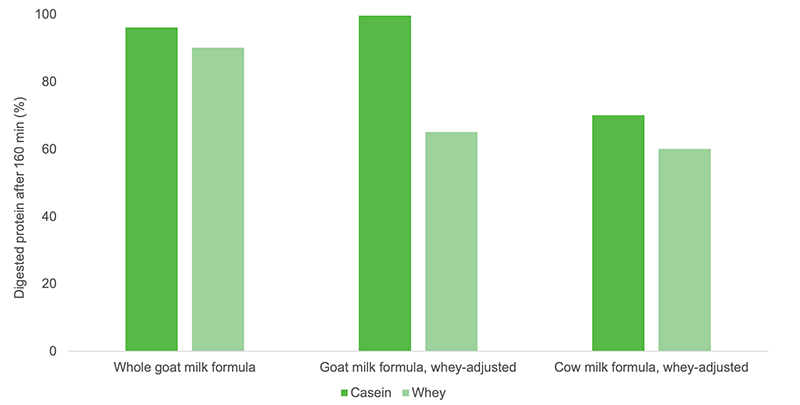
Caseins and beta-lactoglobulin from whole goat milk formula are more efficiently digested than those from cow milk formula (in vitro model)8, and beta-lactoglobulin is also more efficiently digested in whole goat milk formula compared to whey-adjusted goat and cow formula. This can further lower the allergic trigger potential of whole goat milk formula. Calculated assuming 60% whey with same composition as reported in Amalfitano et al. (2020)2 and Li et al. (2022).3
Casein and whey proteins are more effectively digested in whole goat milk formula8
Lower triggering potential in those with hypersensitivities
While goat milk formulas are not suitable for infants or toddlers with established IgE-mediated cow milk allergy (CMA) due to possible cross-reactivity, lower levels of key allergens and more efficient digestion may benefit those with hypersensitivities. Lower levels of alpha-S1 casein, for example, have been shown to lead to a more muted inflammatory reaction in sensitised mice compared to exposure to high levels.9
References
1 Zhou et al. Br J Nutr 2014;111: 1641-1651.
2 Amalfitano et al. J Dairy Sci 2020;103: 11190-11208
3 Li et al. Foods 2022;11: 1737
4 Jensen et al. World Allergy Org J 2022;15: 100668
5 Data on File. Unpublished.
6 Wang et al. Food Hydrocolloids 2019;96: 161-170
7 Zhang et al. Food Funct 2022;13: 6484-97
8 Ye et al. Int Dairy J 2019;97: 76-85
9 Hodgkinson et al. J Dairy Sci 2012;95: 83-90