Natural Bioactives
Natural Bioactives
Capricare® whole goat milk formula supports key benefits, by design. Made with whole goat milk as the only source of protein and ~50% of fat from the goat milk fat, Capricare® naturally delivers components that support the growth and development of infants and toddlers.
Naturally delivers Milk Fat Globule Membrane (MFGM)
The milk fat in whole goat milk formula naturally delivers MFGM. MFGM from human milk, and other mammal milks such as goat milk, contains key components such as glycophospholipids, sphingolipids, cholesterol and bioactive proteins.1,2
These components have been linked to key benefits1-3:
- MFGM proteins have antiviral, antibacterial and immunomodulatory properties
- Phospholipids and cholesterol are important for brain development
- Sphingolipids in MFGM are involved in gut maturation
- MFGM has also been found to support gut microbiota development
Most infant formulas add vegetable oil as the fat source, therefore do not naturally deliver MFGM. Our research shows that Capricare® whole goat milk formula contains near intact MFGM, delivering all of its beneficial components.2
MFGM from goat milk fat delivers phospholipids, sphingomyelin and bioactive proteins

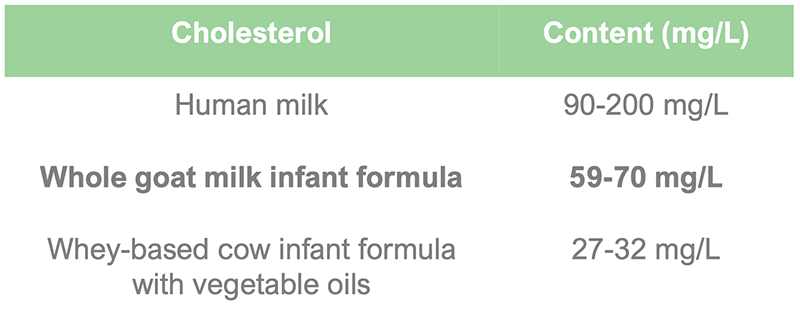
Cholesterol is important for the development of the brain and nervous system2,3
Capricare® whole goat milk formula naturally delivers higher levels of cholesterol than formulas with a fat source from vegetable oil. Cholesterol is essential for the development of myelin sheaths in the brain and nervous system.2,3 Evidence shows that infants fed standard cow milk formula with a fat source from vegetable oil have lower serum cholesterol levels compared to breastfed infants.3
Whole goat milk formula delivers around 2x the cholesterol levels of standard formula2
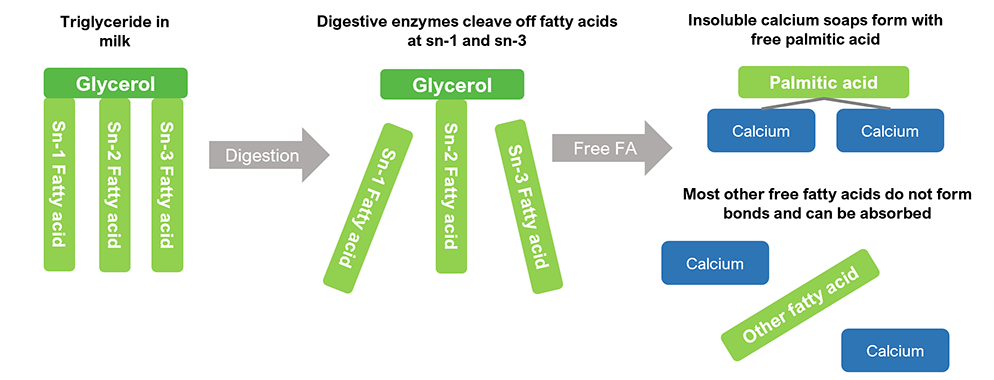
Higher levels of sn-2 palmitic acid for softer stools
Whole goat milk formula naturally delivers higher levels of sn-2 palmitic acid (~30% of palmitic acid) thanks to its high goat milk fat content compared to standard formula with fat sourced from vegetable oil (~5% of palmitic acid).2
Naturally delivers nucleotides for the developing immune system5,6
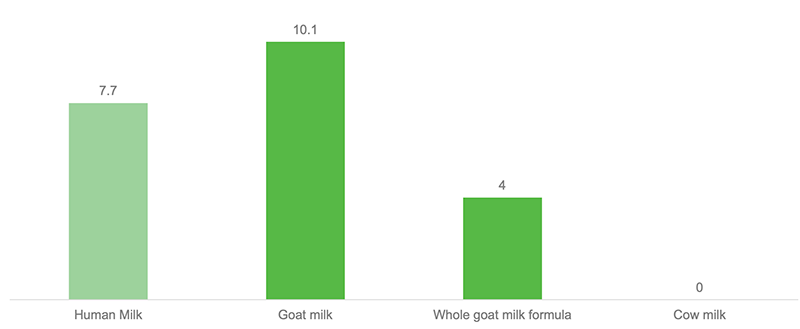
Similar to human milk, goat milk naturally contains nucleotides.7,8 Capricare® whole goat milk formula naturally delivers meaningful amounts of nucleotides, which have been shown to support a developing immune system.5,6 Nucleotides modulate the immune response and evidence suggests they improve immune response to vaccinations, and infants receiving nucleotide-supplemented infant formula had fewer episodes of diarrhoea.5,6 Cow milk does not naturally contain significant levels of nucleotides.
Goat milk naturally delivers nucleotides8
Naturally higher in milk oligosaccharides for healthy gut microbiota9,10
Human Milk Oligosaccharides (HMOs) are complex sugars (oligosaccharides) found in high concentrations in human milk. They are the third most abundant component in human milk, where they serve as prebiotics, selectively nourishing beneficial gut bacteria like Bifidobacteria, which helps shape a healthy infant microbiome. They have other important roles, such as protecting against pathogens, modulating immune responses, and supporting brain development.11
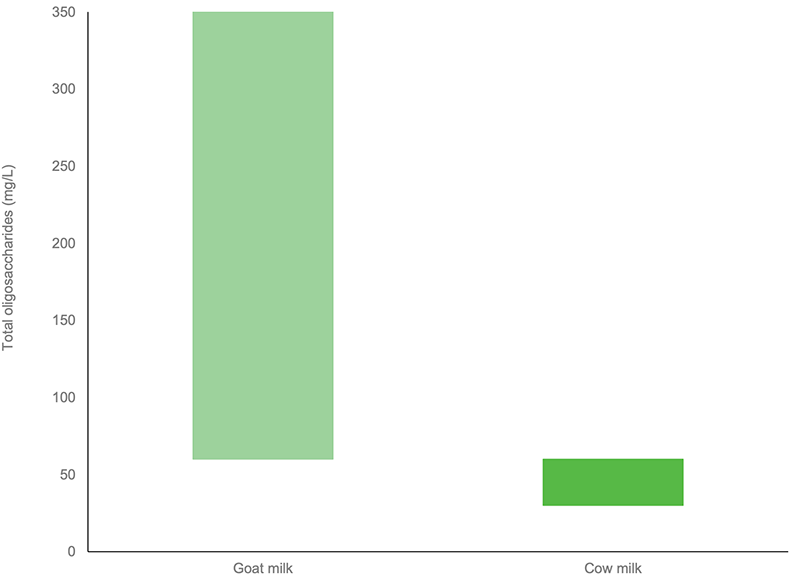
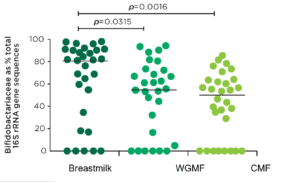
The scientific literature reports that goat milk naturally contains up to 6x higher levels of oligosaccharides, than cow milk, including oligosaccharides that are similar to those in human milk.12,13 Studies investigating the impact of whole goat milk on the gut microbiota demonstrated that infants fed whole goat milk formula had a gut microbiota more similar to a breastfed infant, when compared to cow milk formula. Whole goat milk formula was shown to be bifidogenic.9,10
Goat milk naturally contains higher levels of oligosaccharides12
*Without added oligosaccharides
Difference in presence of bifidobacteria in infants fed breastmilk, whole goat milk formula and cow milk formula
References
1 Demmelmair et al. Nutrients 2017;9: 818
2 Gallier et al. Nutrients 2020;12: 3486
3 Hernell et al. J Pediatr 2016;173S: S60-5
4 Miles & Calder. Nutr Res 2017;44: 1-8
5 Scientific Committee on Food, 2023. Report of the Scientific Committee on Food on the Revision of Essential Requirements of Infant Formulae and Follow-on Formulae.
6 Gutierrez-Catrellon et al. Br J Nutr 2007;98(Suppl 1): S64-7
7 European Food Safety Authority. EFSA J 2014;12(7): 3760
8 Prosser et al. Int J Food Sci Nutr 2008;59(2): 12-133
9 Tannock et al. Appl Environ Microbiol 2013;79: 3040-3048
10 Gallier et al. Front Nutr 2020;7: 608495
11 Corona et al. Children 2021;Sep 14;8(9):804
12 Van Leeuwen et al. J Agr Food Chem 2020;68: 13469-13485
13 Donavan & Comstock. Ann Nutr Metab 2016;69(S2): 42-51