Overview
This growth and tolerance clinical trial used a large cohort of infants (about 100 per formula-fed group) monitored from enrolment at 2 weeks to 12 months of age to rigorously validate our previous findings on the safety and nutritional adequacy of whole goat milk formula. The study outcomes were extended to provide exploratory information on eczema, food allergy, and stool microbiota.
Methods
Principal Investigator: Professor Maria Makrides, Human Nutrition, University of Adelaide, Australia.
Ethics approval: Australian New Zealand Clinical Trials Registry ACTRN12608000047392
Formulations: Manufactured New Zealand Whole Goat Milk Formula (20:80 whey to casein ratio; more than 50% total fat from goat milk; no added whey) and similar commercially available CMF (60:40 whey to casein ratio; vegetable oils as a source of fat).
In this double-blind randomised control trial, healthy newborns (up to two weeks old) from Adelaide, Australia, were enrolled and randomly assigned to WGMF (n=101) or CMF (n=99). A breastfed cohort of infants (n=101) was included as a reference group (exclusively breastfed until 4–6 months).
Formula-fed infants exclusively consumed their assigned formula from randomisation until they were at least four months old, when complementary foods could be introduced. Both formulas were nutritionally designed to meet international standards and differed primarily in protein source and fat composition. Both caregivers and researchers were unaware of which formula was given.
Infants’ growth (weight, length, and head circumference) was regularly measured (see below), and nutritional status was assessed at four months of age using blood biomarkers albumin, creatinine, haemoglobin, PCV, urea, folate, ferritin). The structured interviews with parents provided information about bowel motions (Bristol Stool Scale), sleep patterns (Sleep and Settle Questionnaire), atopic dermatitis (SCORAD), allergy and gastrointestinal symptoms using questionnaires. Health outcomes and general illnesses were also monitored.

Key findings
WGMF was well tolerated and supported normal growth (weight, length, head circumference, and weight for length of infants up to 12 months of age), which was not different between the formula-fed groups.

The nutritional adequacy of WGMF was demonstrated with all blood biochemical markers within the reference range of the monitored 4-month-old infants (when infants are only receiving breast milk or formula). There were minor differences from some blood biochemical markers between the formula-fed groups which could reflect differences in formula compositions.
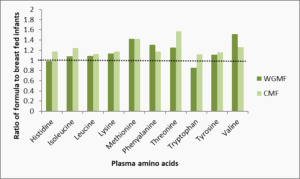
WGMF is made according to CODEX standards and does not contain added whey. The analysis of blood amino acid levels in 4-month-old infants demonstrated that the WGMF delivered the required amounts of essential and semi-essential amino acids.
The TIGGA study findings also indicate that WGMF potentially improves other nutritional outcomes for infants:
- A trend for lower incidence of non-trivial atopic dermatitis (SCORAD >10) for infants consuming WGMF was observed.2
- The gut microbiota of infants consuming WGMF was closer to the breast-fed reference group than infants fed CMF (faecal stool samples were collected from 30 infants of each group at 2-month-old).3
Other health outcomes, including common illnesses, allergy-related conditions, and sleep patterns, were similar between WGMF-fed infants and those breastfed. The incidence of parent-reported blood-stained stools was slightly higher in the WGMF group than in breastfed infants; however, this occurred in a small number of cases, and its clinical significance remains unclear.
Conclusion
The TIGGA growth and tolerance study provided robust data on the safety and nutritional adequacy of whole goat milk infant formula in the first 12 months of life. The study findings, alongside other research from Dairy Goat Co-operative (N.Z.) Ltd, led to the positive conclusion from EFSA’s Panel on Dietetic Products, Nutrition and Allergies that protein from goat milk can be suitable as a protein source for infant and follow-on formulae, provided the final product complies with the compositional criteria laid down in Directive 2006/141/EC.4
References
CMF: cow milk formula; EFSA: European Food Safety Authority; WGMF: whole goat milk formula.
1 Zhou et al. Br J Nutr. 2014; 111(9):1641–1651.
2 Carpenter and Prosser ESPGHAN Poster presentation. 2017, May 10–13.
3 Tannock et al. Appl Environ Microbiol. 2013, 79:3040-3048
4 EFSA Panel on Dietetic Products, Nutrition and Allergies (NDA). EFSA J. 2012;10(3):2603. [18pp.].