Questions fréquemment posées

Chez Capricare®, nous comprenons que les parents et les professionnels de santé se posent de nombreuses questions sur nos produits. Pour vous aider à faire des choix éclairés, nous avons compilé une liste des questions les plus fréquentes sur notre lait maternisé au lait de chèvre entier. Pour toute question complémentaire, n'hésitez pas à nous contacter.

No results found

About Capricare® Whole Goat Milk Infant Formula

Qu'est-ce que le lait maternisé Capricare® ?

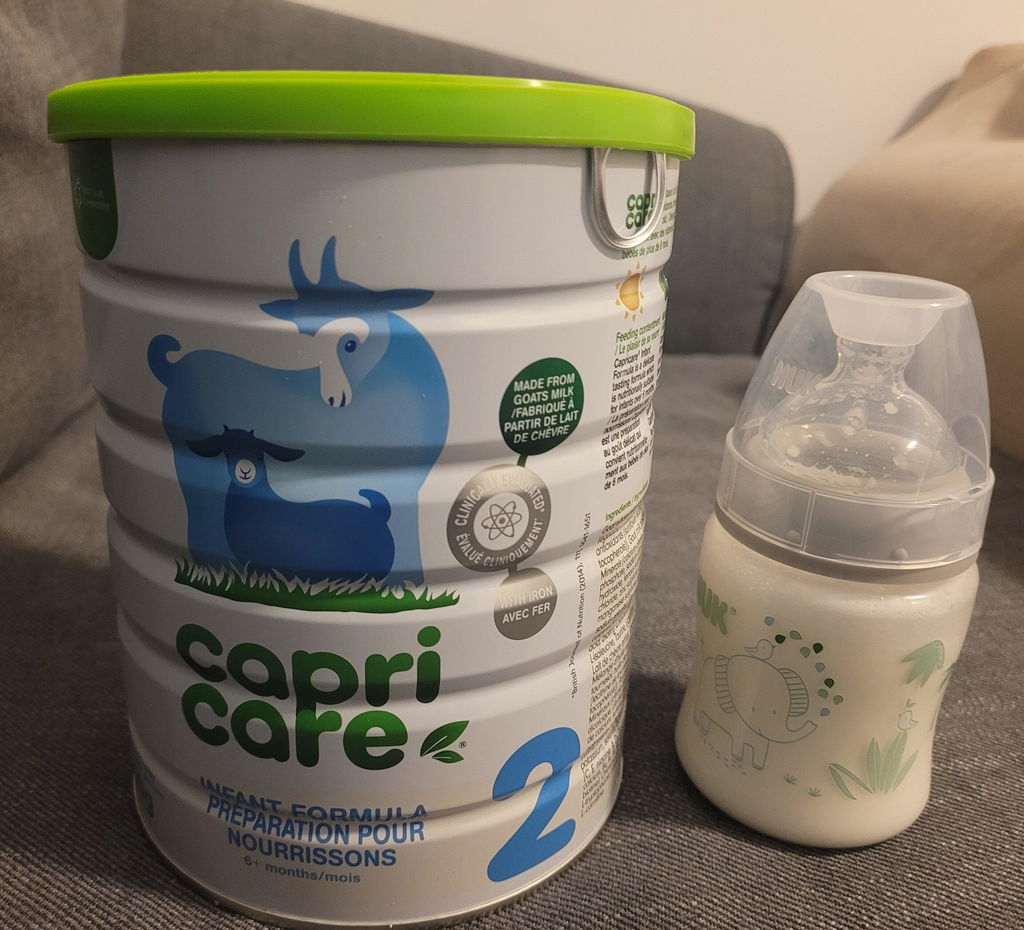
Capricare® est une préparation infantile à base de lait de chèvre entier. Cette formule nutritionnellement complète a été conçue pour accompagner les bébés dès la naissance, grâce à un lait plus doux, naturellement riche en nutriments essentiels.

Capricare® est fabriqué par Dairy Goat Co-operative, pionnier et leader mondial des laits infantiles à base de lait de chèvre. Basée en Nouvelle-Zélande, Dairy Goat Co-operative appartient aux agriculteurs qui fournissent le lait. Leurs exploitations sont situées sur des pâturages parmi les plus riches du pays.

Pourquoi Capricare est-elle une bonne formule à choisir ?

Capricare est fabriqué à partir des bienfaits naturels du lait de chèvre entier, fabriqué en douceur, protégeant les nutriments essentiels.

Pourquoi les préparations pour nourrissons au lait de chèvre entier sont-elles supérieures aux préparations pour nourrissons au lait de vache ?

Le lait de chèvre entier présente des caractéristiques uniques qui le rendent plus proche du lait maternel, notamment :

  1. Environ 50 % de matières grasses du lait de chèvre entier, présentes uniquement dans les préparations pour nourrissons au lait de chèvre entier, fournissent naturellement des composés bénéfiques qui sont importants pour le développement sain du cerveau, du système immunitaire et des intestins.
  2. Profil protéique naturel, qui forme un caillé naturellement doux et plus doux pour les petits ventres, est plus faible en allergènes clés et est naturellement « A2 » (ne contient que de la bêta-caséine de type A2).
  3. Bioactifs respectueux de l'intestin à des niveaux naturellement plus élevés, y compris environ 6 fois plus d'oligosaccharides dans le lait de chèvre que dans le lait de vache, et des nucléotides délivrés naturellement.
Pourquoi Capricare® propose des formules de stade 1 et de stade 2 ?

Le lait de stade 2 est plus riche en plusieurs micronutriments, notamment en vitamine D, en acide folique, en calcium et en fer. Les besoins quotidiens en nutriments augmentent avec l'âge, et certains de ces besoins accrus sont parfois difficiles à satisfaire lors de la transition vers les aliments solides. Les apports de notre lait de stade 2 ont été optimisés pour répondre à ces besoins supplémentaires.

Quelle est l'odeur et le goût de Capricare® ?

Notre lait provient de chèvres bien nourries et élevées dans des conditions saines. Il est ensuite traité avec douceur tout au long du processus de fabrication des préparations pour nourrissons. Il en résulte une préparation pour nourrissons onctueuse et douce au goût.

Comment sont déterminés les dosages pour les formules Capricare® Stage 1 & 2 ?

Le nombre de mesures par repas et par jour est déterminé en fonction des besoins nutritionnels du nourrisson, en fonction de son âge et de son stade de développement. Les recommandations alimentaires de Capricare servent de guide pour garantir que les nourrissons reçoivent les nutriments appropriés, en fonction du nombre de mesures par repas et par jour.

Capricare® convient-il aux nourrissons allergiques au lait de vache ?

En raison des protéines similaires présentes dans le lait de vache et le lait de chèvre, les préparations à base de lait de chèvre ne peuvent pas être recommandées aux nourrissons ayant reçu un diagnostic d'allergie au lait de vache (IgE).

Cependant, comme la quantité de protéines allergènes clés (β-lactoglobuline et αS1-caséine) est beaucoup plus faible dans la formule au lait de chèvre entier Capricare ®, sans protéine bêta-caséine A1, de nombreux parents trouvent qu'il s'agit d'une option plus douce pour les bébés souffrant d'intolérance au lait de vache (et non d'allergie).

Les formules Capricare® sont-elles sans gluten ?

Oui, les produits Capricare® sont sans gluten. Ils sont fabriqués dans une usine qui ne traite pas de produits contenant du gluten, et les allergènes sont testés par des organismes indépendants conformément aux normes réglementaires.

How many servings are there per can? 

Each can contains 800 g of formula. One level scoop provides approximately 4.3 g. Feeding requirements vary by stage and age: Stage 1 typically uses 3–7 scoops per feed, providing approximately 27–62 servings per can, while Stage 2 uses 7 scoops per feed, providing approximately 27 servings per can.

How long has goat milk formula been around?

Goat milk infant formula was first used in New Zealand and Australia over 30 years ago. Capricare® is made by Dairy Goat Co-operative, the pioneer and inventor of goat milk infant formula.

Is Capricare® the same as Hipp or Holle Goat Milk Formula?

No, Hipp and Holle are NOT the same as Capricare®. Hipp uses skim goat milk and adds palm oil and rapeseed oil, unlike Capricare®. Holle uses whole goat milk, but adds rapeseed oil and maltodextrin.

How does Capricare® compare to goat milk formulas that can be ordered from Europe?

Capricare® is trusted by families in 36 countries, including Canada, and is available internationally under a range of established brand names. While brand names may vary by region, examples include Nannycare in the United Kingdom and Karicare in Australia and New Zealand. Capricare® is not sold under any brand name in the United States.

Using Capricare®

How to use Capricare®?

Make sure to prepare the bottle just before feeding your baby, following these steps: 

  1. Sterilize: Always wash your hands and countertops before preparing the baby’s bottle. Sterilize bottles, nipples, caps and other equipment by boiling in an open pan of water for at least 2 minutes. Boil fresh water for 2 minutes and allow to cool to room temperature. 
  2. Measure: Pour the required amount of cooled, boiled water (refer to feeding guide) into a sterilized bottle. Add the required number of level scoops of powder. 
  3. Prepare: Close the bottle. Immediately shake well until the powder is completely dissolved. 
  4. Test: Check the temperature of the preparation by sprinkling a few drops on the inside of your wrist. 
How should I transition my baby from breast milk or another formula to Capricare®?

To support a gentle transition, it’s recommended to introduce Capricare® gradually over a period of 3–7 days. Begin by replacing one scoop of your current formula with one scoop of Capricare® when preparing a bottle. After 1–2 days, replace an additional scoop with Capricare®. Continue this gradual approach until all scoops are from Capricare®.

If my baby has an allergy to cow milk, can they have goat milk? 

Due to the similar proteins in cow and goat milk, goat milk cannot be recommended to infants diagnosed with a cow milk protein allergy (CMPA). However, because the amount of allergenic protein (as1-casein) is much lower in goat milk than cow milk, with no A1typebeta-casein protein, goat milk infant formula is often perfect for those with a cow milk intolerance or hypersensitivity.

Can Capricare® be mixed with other formulas?

Formula is designed to deliver specific amounts of nutrients in each scoop. It is okay to mix formulas for a short term (3-7 days) when switching from another formula. Mixing formulas for a longer period runs the risk of making feeds over or under concentrated causing potential discomfort or an imbalance of nutrients.

What is Capricare®’s shelf life?

Capricare® whole goat milk formula has a shelf life of 36 months when stored unopened under recommended conditions. Goat milk fats can be more sensitive to oxidation, which may contribute to a stronger flavour in some goat milk products. Capricare® carefully manages milk handling through a maintained cold chain and uses gentle processing methods that rely on pressure rather than heat to help preserve quality and taste. As a result, Capricare®’s goat milk has a mild, clean flavour that is similar to cow milk.

Ingredients

What does a GMO-free infant formula mean?

A GMO-free formula is made without genetically modified organisms. This means none of the ingredients are derived from crops or animals that have been genetically altered in a lab, offering peace of mind to parents seeking more natural feeding options.

Why does Capricare® contain bovine lactose?

Lactose is the main carbohydrate found in breast milk — it’s a key source of energy for babies and helps support the growth of healthy gut bacteria and as such is required by Health Canada to be included in infant formulas. Because goat milk doesn’t naturally have enough lactose on its own to meet a baby’s needs, we add a purified lactose to bring it up to the levels required in infant formula. 

The lactose we use is derived from cow milk, which is chemically identical to human and goat milk lactose. Only the lactose (the carbohydrate) is used — all cow milk proteins and other components are removed during processing. These proteins are what typically cause allergic reactions in babies, not lactose itself, so the added lactose does not increase allergy risk.  

However, it’s important to note that due to potential cross-reactivity between proteins in cow and goat milk, goat milk formula cannot be recommended to infants with a diagnosed cow milk allergy (IgE). 

Why are probiotics not included in your formulas?

Probiotics are living bacteria that when added to food/supplements must be done so in sufficient quantities to survive transit through the gut and deliver a health benefit. In contrast, prebiotics, such as oligosaccharides, play an important role in feeding the bacteria in the gut. Whole goat milk contains naturally higher levels of oligosaccharides, a prebiotic, when compared to cow milk. Whole goat milk, such as Capricare®, has been shown to deliver health benefits, such as a greater reduction in regurgitation and easier digestion, compared to cow milk, and has been shown to have a bifidogenic effect, without the need for probiotics. 

Are vegetable oils used in the Capricare® formulas?

Capricare® uses natural whole goat milk fats as a base, which reduces the amount of added vegetable oils needed. However, to meet babies’ needs of essential fatty acids it is necessary to add some Omega-6 and Omega-3 rich vegetable oils, in our case canola and sunflower oils from non-GMO sources. The Omega-6 fatty acid LA (linoleic acid) is essential in infant formula for the necessary immune and inflammatory system development to fight infections. The Omega-3 fatty acid ALA (alpha-linolenic acid) is another essential fatty acid and is a precursor of the long-chain Omega-3 fatty acid DHA, which supports brain development.  

Canola and soy are the most abundant sources of LA. Capricare® chose canola because soy is a known allergen. Capricare® canola oil is non-GMO (canola is a rapeseed hybrid plant bred to be safer with lower levels of erucic acid & glucosinolates). Canola is also a source of omega-3 ALA. 

Capricare® has no added palm oil.

What is the difference between A1 and A2 beta-casein, and why is it important?

Beta-casein is a protein found in milk, and there are two key genetic variants of beta-casein: A1-type and A2-type. 

Regular cow’s milk typically contains a mix of both A1 and A2 types of beta casein. Goat’s milk beta-casein is only A2 type and is naturally free of A1 type beta-casein—just like human breastmilk (also only A2 type, no A1 type). 

Being A1 or A2 type beta-casein has implications for digestive health because A1 type beta-casein can cause digestive comfort and increased gut inflammation, and it can lead to slowed gut motility, which increases the time for gut microbes to ferment lactose in the milk and cause symptoms (eg. gas and tummy discomfort). With A2 type beta-casein does not cause this digestive comfort, and everything moves faster through the gut, and the gut bacteria have less time to ferment lactose and produce symptoms.

Sourcing & Manufacturing

Where is Capricare® from?

Capricare® is made by Dairy Goat Co-operative, the pioneer and world leader of goat milk infant formulas. Dairy Goat Co-operative is based in New Zealand and owned by the farmers who supply the milk. Their farms are on some of New Zealand’s richest pastures.

What is a co-operative?

A co-operative is a business owned and operated by its members (in our case, the farmers), who work together for shared success. Unlike corporations, profits are reinvested into the business and shared among farmer-members. This ensures quality, integrity, and long-term sustainability over short-term profits.

How are the goats farmed?

The goats are sheltered using open-sided barns that allow exposure to natural lighting and fresh air. Space is provided to allow goats to move freely or lie down. Goats are given free access to their food.

Do farmers use antibiotics?

The use of all drugs, including antibiotics, is highly regulated in New Zealand where Capricare® is made. Antibiotics are used in some exceptional circumstances to treat infections. In this case all milk collected during the treatment period and several days after treatment is discarded. Milk is routinely tested at each delivery to ensure it is free from antibiotic residues.

What are Capricare® formulas tested for?

We test for heavy metals, antibiotic and mycotoxin residues, pesticides, and yeasts,moulds, and bacteria. ​We also test for foreign materials (e.g. plastic, glass, metal) and plasticizers to ensure the highest quality formula on the market.

Is Capricare® certified organic?

Capricare® is not certified organic. However, we conduct comprehensive quality testing to ensure the highest standards of safety and purity. Finished powders are tested annually, with routine testing performed on base powders for heavy metals, antibiotic and mycotoxin residues, pesticides, and microbial contaminants such as yeasts, moulds, and bacteria. Additional testing is carried out for foreign materials, including plastic, glass, and metal, as well as plasticizers, to ensure the highest quality formula on the market.