
Confort digestif
Confort digestif
Plusieurs études confirment la douceur naturelle et les avantages digestifs des préparations à base de lait entier de chèvre
Une étude de cohorte prospective menée auprès de 976 nourrissons coréens de la naissance à 12 mois a révélé que la préparation à base de lait entier de chèvre entraînait une consistance et une fréquence des selles plus similaires à celles des nourrissons allaités, par rapport à la préparation à base de lait de vache.1
Comparaison de la fréquence et de la consistance des selles entre la préparation à base de lait entier de chèvre, la préparation à base de lait de vache et le lait maternel1
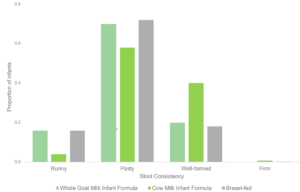
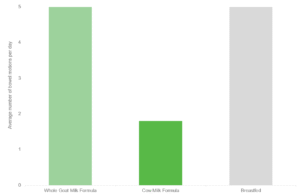
Adapté de Han Y, et al. 20111
Réduction moyenne de la fréquence des régurgitations (fois/semaine) de la randomisation à 4 semaines
Une tendance à une plus grande réduction des régurgitations rapportées par les parents a été observée chez les nourrissons passant de l'allaitement maternel à une préparation à base de lait entier de chèvre, par rapport à une préparation standard à base de lait de vache. Au total, 80 nourrissons ont été randomisés pour étudier l'impact sur la fréquence des régurgitations sur 4 semaines lors du passage de l'allaitement maternel à l'alimentation au lait infantile. Malgré une fréquence de régurgitation plus élevée dans le groupe lait entier de chèvre au départ, les deux groupes ont eu une fréquence de régurgitation similaire après 4 semaines.2
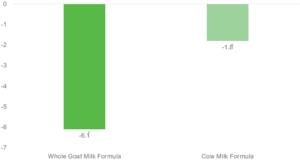
Adapté de Suteerojntrakool O et al. 2025 2
*P =0,09. Les résultats montrent uniquement une tendance à la signification.
Attributs uniques de Capricare® pour le confort digestif
Coagulum naturellement doux grâce à des niveaux plus faibles de caséine alpha-S1
Le lait humain forme naturellement un coagulum doux dans l'estomac grâce à ses niveaux naturellement plus faibles* d'une protéine appelée caséine alpha-S1 (environ 5 % des protéines5). Comme le lait humain, le lait de chèvre utilisé dans Capricare® a également des niveaux naturellement plus faibles* de caséine alpha-S1 (environ 8 %4), ce qui conduit également à un coagulum naturellement doux.5 Le lait de vache forme un coagulum plus dur5, en raison de niveaux plus élevés de caséine alpha-S1 (environ 28 %6) – l'ajout de lactosérum aux préparations de vache aide à adoucir le coagulum5 et le rend plus facile à digérer pour les nourrissons. La préparation à base de lait entier de chèvre est naturellement douce sans avoir besoin d'ajouter du lactosérum.
Le lait de chèvre utilisé dans Capricare® est naturellement moins riche en caséine alpha-S1 3-6, ce qui le rend plus facile à digérer
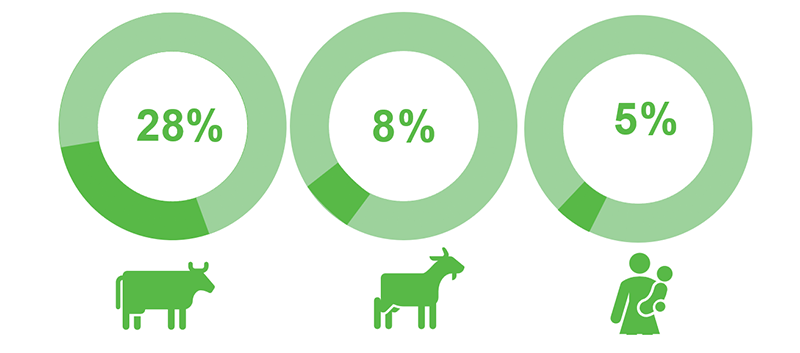
caséine alpha-S1 en % des protéines totales
Naturellement A2 pour le confort digestif
Tout comme le lait humain, le lait de chèvre ne contient naturellement que des bêta-caséines de type A2 et aucune bêta-caséine de type A1.7
Les bêta-caséines de type A1 ne sont présentes que dans le lait bovin et ont été associées à un inconfort digestif8,9 et à une inflammation intestinale.9 Cela s'explique par le fait que les bêta-caséines de type A1 du lait de vache libèrent des niveaux élevés d'un peptide appelé bêta-casomorphine 7 (BCM-7), qui a été associé aux effets négatifs des bêta-caséines de type A1.9
Le lait ne contenant que des bêta-caséines de type A2 a montré qu'il ne libérait pas ou très peu de BCM-79 et qu'il apportait des avantages pour le confort digestif, la consistance et la fréquence des selles.8,9
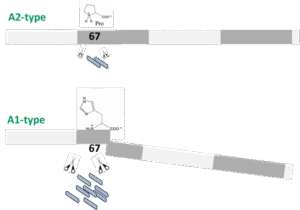
La bêta-caséine A2 contient de la Proline en position 67, tandis que la bêta-caséine A1 contient de l'Histidine, ce qui rend l'A1 plus susceptible au clivage enzymatique et à la libération de BCM-7 pendant la digestion.
Niveaux plus élevés d'acide palmitique sn-2* pour des selles plus molles
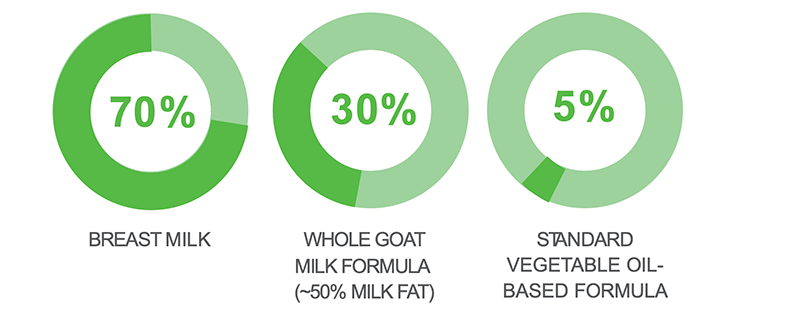
Capricare® contient environ 50 % de matières grasses provenant du lait de chèvre, fournissant naturellement des niveaux plus élevés d'acide palmitique en position sn-2**10, ce qui a été lié à des avantages digestifs, y compris des selles plus molles et moins de pleurs.11
Lorsque l'acide palmitique est en position sn-1 ou sn-3 d'un triglycéride (la principale forme de graisse), il est clivé par l'enzyme digestive et devient un acide gras libre qui forme ensuite des savons avec le calcium, rendant le calcium et l'acide gras indisponibles pour être absorbés par le corps. Cela conduit à des selles plus dures et réduit l'absorption du calcium. L'acide palmitique en position sn-2 ne forme pas de savons et est facilement absorbé.11
Proportion d'acide palmitique en position sn-2
Références
1 Han et al. Nutr Res Pract 2011;5(4): 308-312
2 Suteerojntrakool et al. (2025, February 20-22). [Présentation orale, résumé]. Conférence Nutrition & Croissance, Athènes, Grèce
3 Liao et al. J Proteome Res 2017;16: 4113-4121
4 Données en dossier. Non publiées.
5 Wang et al. Food Hydrocolloids 2019;96: 161-170
6 Amalfitano et al. J Dairy Sci 2020;103: 11190-11208
7 Rahmatalla et al. Front Genet 2022;13: 995349
8 Sheng et al. J Pediatr Gastroenterol Nutr 2019;69(3): 375-3
9 Brooke-Taylor et al. Adv Nutr 2017;8(5): 739-748
10 Gallier et al. Nutrients 2020;12: 3486
11 Miles & Calder. Nutr Res 2017;44: 1-8
*Par rapport aux formules standard avec huile végétale comme source de matières grasses
**Par rapport à la formule de lait de vache